
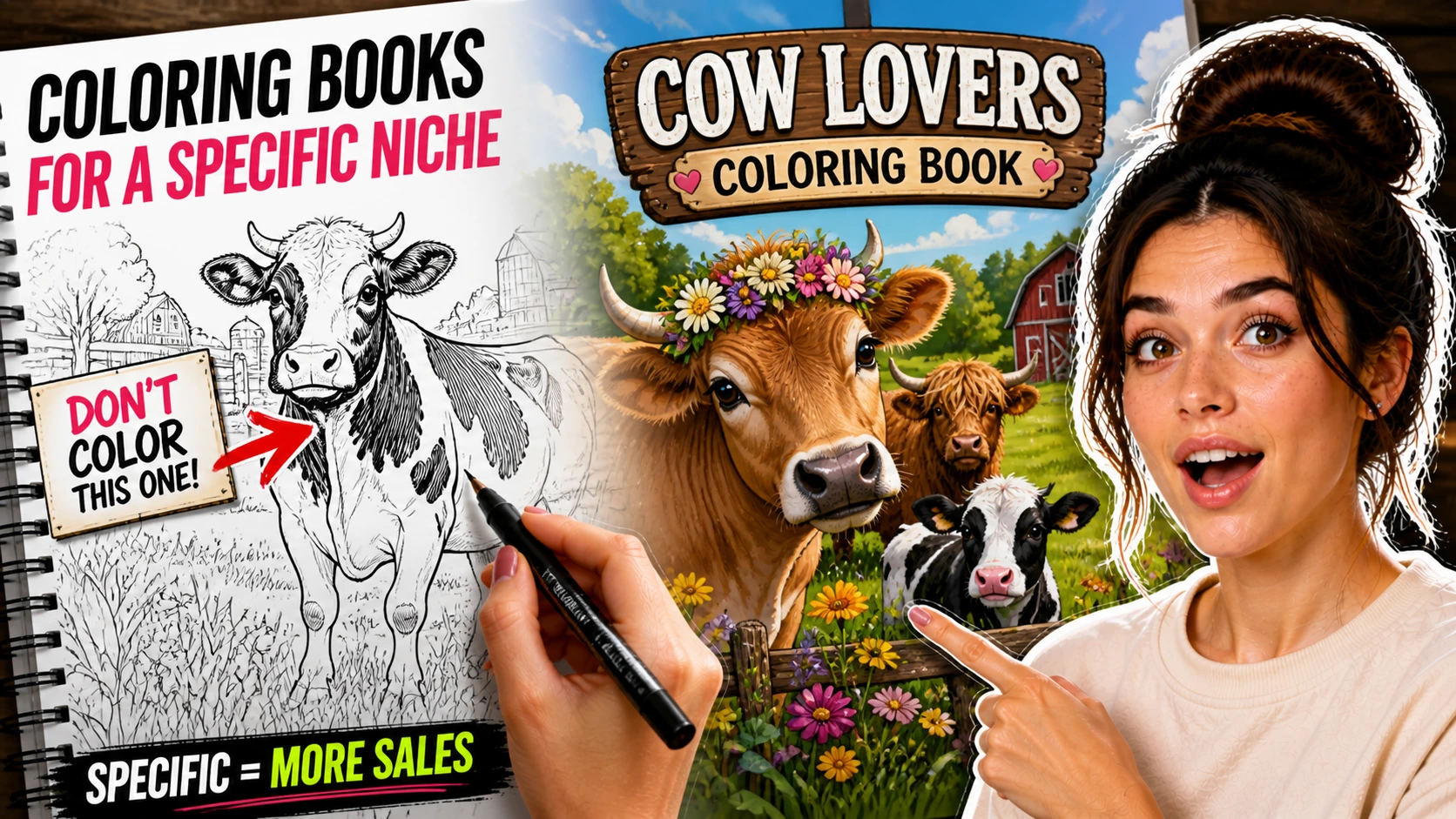
Coloring Books for a Specific Niche You Can Make with AI
A coloring book can seem nicely themed until you stop and ask who would actually want it. “Whimsical objects and cheerful scenes” may sound cute, but it does not point to a real buyer, a real mood, or a real reason someone would choose that book over the many others already out there.
That is the issue with a lot of coloring book ideas that seem creative at first.
Cute is not enough, and vaguely pretty is not enough either. A coloring book gets much easier to sell when it is clearly made for a specific kind of person, interest, age group, or mood. A book about cozy cottages for adults who want a calm evening activity is easier to picture.
So is a vehicle coloring book for preschoolers, or a gentle plant-themed book for houseplant lovers who already enjoy slow, visual hobbies.
Specificity helps the buyer recognize themselves in the product. It also helps you make better choices while building the book.
When the Theme Starts Doing Real Work
A niche coloring book is not just any coloring book with a title on the front. It is a book built around a clear audience and a clear theme that stays consistent from the cover to the final page.
That focus changes the product.
It makes it different from a generic coloring book aimed at “all ages.” It is also different from a low-content book that mostly exists to take up space, and different from a printable activity pack that mixes mazes, tracing, puzzles, and coloring pages together. A niche coloring book stays focused on one visual experience and one kind of buyer.
That focus is what makes the product easier to understand in a few seconds.
Someone scrolling through Amazon KDP, Etsy, or a creator’s shop should be able to tell almost immediately what the book is, who it is for, and what kind of experience it offers. And that matters because most people do not buy coloring books randomly.
They buy them because the theme fits something they already care about, like gardening, trucks, faith, woodland scenes, calming nature, or a child’s growing interest in a certain kind of job.
The purchase is usually emotional in a quiet way, tied to taste, routine, or that small feeling of “this is for me” or “this is for my kid.”
Why Broad Concepts Fade Fast
A broad coloring book can include almost anything, which is exactly why it often feels forgettable. If the concept is just “fun things to color,” the pages may not feel connected enough to make the book memorable.
A narrow concept gives the book shape.
Cozy cottage coloring pages for adults suggest warm interiors, garden paths, teacups, reading nooks, rain at the windows, and soft domestic details. Occupation-themed pages for children interested in firefighters or builders suggest a different kind of scene, with simple shapes, familiar tools, and age-appropriate action. That does not mean you need an obscure niche.
It just means the buyer should be easy to picture.
A book for houseplant lovers can work because the audience is clear. A book of calming nature pages for teens can work because the mood and age range guide the design.
A faith-based coloring book can work because the tone, imagery, and likely buyer are all much easier to define than they would be in a generic “uplifting art” book.
What Buyers Notice First
Most buyers are not counting pages first. They are reacting to the feel of the book as a whole, and that comes from theme, consistency, usability, and appeal more than sheer volume.
A random stack of AI-generated pages can technically fill a book.
But if the style changes every few pages, the compositions feel awkward, or the scenes repeat themselves with slightly different props, the book starts to feel thin even when it is long. People can tell when a product exists only because it could be generated.
A thoughtful niche coloring book feels different.
The pages feel like they belong together. That coherence shows up in small ways. The line weight feels similar from page to page, the difficulty level fits the audience, and the image choices support the same overall idea.
Even the order matters, because a buyer notices when the book starts gently, adds variety, and does not drop three nearly identical pages in a row.
Where AI Helps Without Running the Whole Process
AI is genuinely helpful when you are shaping the idea before you make the pages. You can use ChatGPT, Claude, or Gemini to brainstorm niche directions, compare audience angles, come up with page concepts, draft titles and subtitles, and generate product copy that is easier to revise than a blank page.
It can also help with the visual plan.
You can ask for twenty scene ideas for a calming teen nature book, then narrow them to the twelve that feel strongest. You can test prompt wording for black-and-white line art, simple page composition, or a softer cozy style before settling on a consistent visual direction. That speed is useful, especially for beginners who do not come from an illustration background.
But AI does not know which pages are actually pleasant to color.
It does not know which ones feel repetitive, or which ideas technically fit the theme while still making the book feel oddly flat. That is where human judgment matters more than people expect.
You have to choose the audience, set the tone, reject weak images, adjust awkward layouts, and decide whether the book feels coherent when seen as a set instead of as separate pages.
AI can offer options quickly, but it still needs someone to say, “No, this one is too cluttered,” or “These last five pages all feel the same.”
A First Version Can Stay Small
A realistic first coloring book does not need to be huge to feel complete. It needs a concept strong enough that the buyer understands why it exists.
Say you want to make a plant-themed coloring book for houseplant lovers.
A decent first version might include 20 to 30 pages built around indoor plants, shelves, pots, watering scenes, greenhouse corners, plant journals, and cozy windowsills. That is enough to feel like a real themed product if the pages hold together visually and emotionally. The same is true for a vehicle coloring book for preschoolers.
The value is not in complexity.
For that audience, simpler shapes, clean outlines, familiar vehicles, and obvious page-to-page variety matter more than decorative detail. A fire truck, tractor, dump truck, school bus, ambulance, cement mixer, and tow truck can make a stronger book than a vague collection of transportation pages that jumps between realistic sketches, cartoon doodles, and cluttered city scenes.
The first version should feel usable, not overfilled.
Making the Pages Feel Like One Book
One of the easiest ways to weaken a coloring book is to treat each page like its own separate experiment. That is how you end up with a mushroom cottage beside a hyper-detailed Victorian kitchen, followed by a minimalist teapot shelf, followed by a page that somehow looks like clip art.
A stronger process starts with a visual rule set.
Decide the line style, level of detail, framing, and general mood before you generate too many pages. Then keep testing new images against that standard instead of letting every prompt wander. This is where AI can help in a very practical way.
You can use it to write prompt variations that stay inside a chosen style.
You can also use it to brainstorm page order, title ideas, back cover text, and simple front matter copy. But once the images are made, someone still has to look at them like a buyer would.
Do these pages belong together, or do they just share a keyword?
That question saves a lot of books from turning into random collections with matching fonts. Page usability matters too. Some illustrations look good in a preview but are annoying to color because the spaces are cramped, the composition is off balance, or the subject sits awkwardly on the page.
A coloring book is still a functional product, even when the function is leisure.
Packaging Shapes the Experience
A niche coloring book starts feeling real when it is packaged like a finished product. That means a clear title, a subtitle that actually helps, a cover that matches the audience, and preview pages that show the style honestly.
Packaging is not an afterthought.
If you are creating a KDP-style book, the interior needs to be formatted cleanly and sized correctly for print. If you are selling printable PDFs, the file should be easy to download, easy to print, and organized in a way that does not confuse the buyer. If you are selling direct through Gumroad or your own site, the listing copy needs to explain what is included and who the book is for.
This is also where the difference between a coloring book and a printable bundle matters.
A coloring book usually feels more cohesive and more book-like. A printable set can still sell well, especially on Etsy, but the buyer experience is a little different.
People shopping for printables often want quick access, easy home printing, and themed page packs they can use right away.
Buyers looking at KDP listings are usually thinking in terms of a complete bound book, with more emphasis on cover appeal and browse visibility.
Choosing the Right Place to Sell It
Amazon KDP is useful when your product works well as a book-shaped item. It gives you access to people who are already browsing for physical books, and that can make sense for adult coloring books, children’s themes, or seasonal niche concepts that look good as print products.
Etsy is often stronger when the product is digital first.
Printable coloring pages, homeschool-friendly themed packs, holiday sets, and niche downloads aimed at parents or teachers can fit naturally there. The search behavior is different, and buyers are often comfortable purchasing a file they can use the same day.
Gumroad works well when you already have some kind of audience or a direct way to share the product.
It is especially useful for PDF sales, bundles, or niche topics that make more sense when sold alongside related resources. A personal site can work too, especially if the coloring book connects to your broader brand.
A plant creator could sell a houseplant coloring PDF next to journals or guides. An educator could offer occupation-themed coloring books inside a resource shop. In cases like that, the book is not trying to compete with every coloring title on a marketplace.
It is serving a very specific audience that already understands the context.
What Makes People Remember It
A buyer usually remembers the book as a whole, not just one page. They remember whether the theme felt clear, whether the pages were enjoyable to use, and whether the product felt made for someone like them.
That is why a niche coloring book can be such a solid digital product idea when it is handled with care.
You do not need advanced illustration skills to start shaping one with AI, but you do need taste, restraint, and enough attention to make the final book feel intentional. The best ones are not just collections of black outlines.
They feel like someone picked a lane, stayed with it, and made something another person would genuinely be happy to sit down and color.
