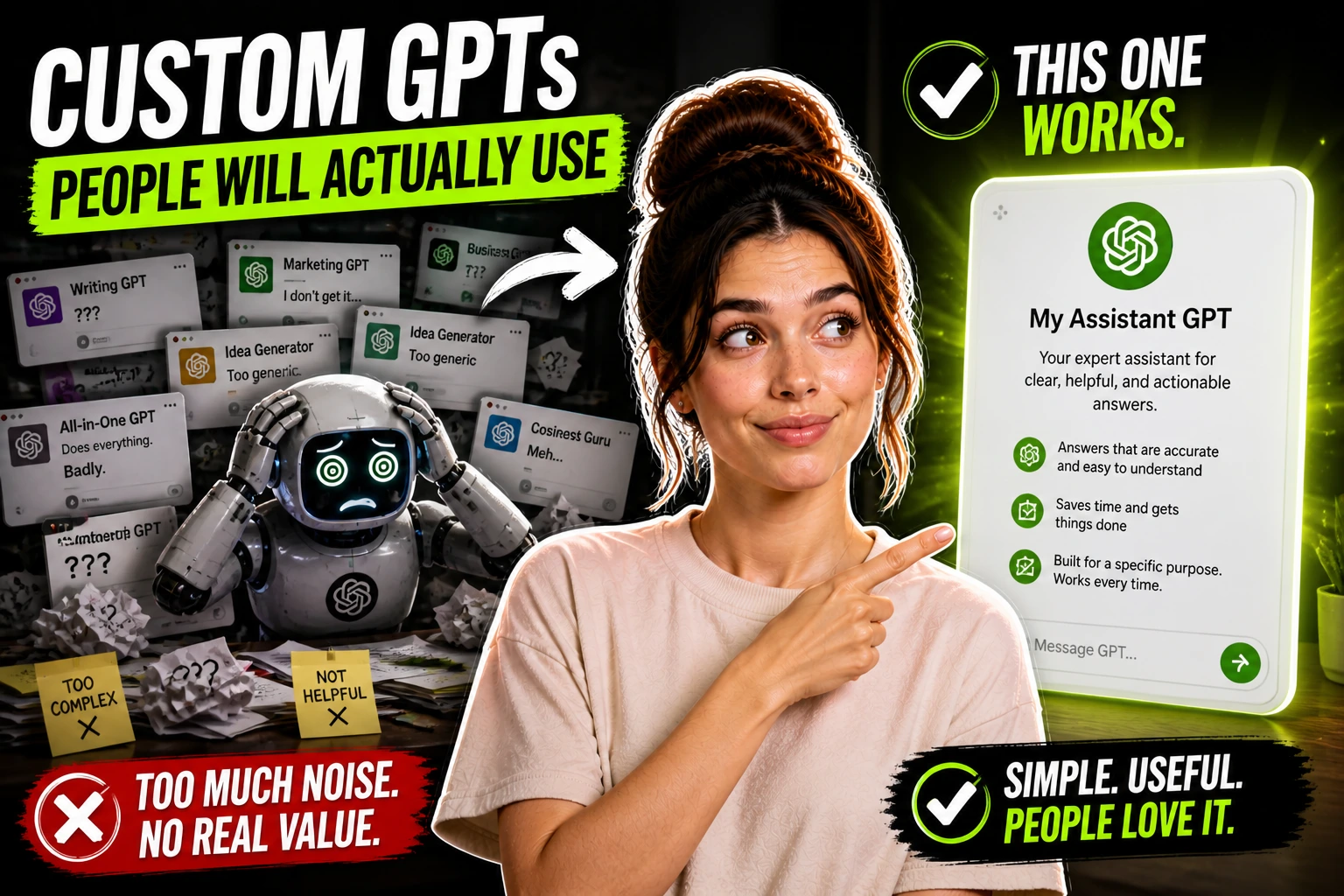
Custom GPTs People Will Actually Use
A custom GPT can sound impressive on paper and still feel oddly useless the moment someone tries it. “Your all-in-one business brainstorming assistant” sounds smart, polished, and maybe a little futuristic, but in practice it often gives the kind of vague output that looks productive without helping anyone actually finish anything.
That is the gap a lot of people run into.
Interesting is not the same as useful, and clever branding is not the same as solving a problem. A custom GPT becomes valuable when it helps a real person complete a repeated task more clearly, more quickly, or with less friction than they could on their own.
That shift matters if you want to turn a GPT into a product.
People are not usually paying for the existence of an AI tool. They are paying because a narrow tool helps them get through one annoying or important job without having to rebuild the process every time. So the strongest custom GPTs are rarely the broadest ones.
They are the ones with a clear user, a clear job, and enough boundaries that the output starts to feel dependable. That is what moves a GPT from novelty into something a creator, consultant, educator, or freelancer can actually package and sell.
More Like a Guided Tool Than a General Chatbot
A custom GPT is basically a version of an AI assistant shaped for a specific purpose. You set instructions, tone, scope, examples, and sometimes supporting files so it responds in a more focused way than a blank chat window.
That makes it different from a general chatbot.
The point is not open-ended conversation. It is also different from a prompt pack, because the user is not copying and pasting a string of prompts and hoping they remember what to say next.
And it is not a full software app either.
It usually does not have complex workflows, databases, or automations running behind the scenes. That distinction helps with pricing and positioning.
When people treat a custom GPT like full software, expectations get inflated fast. When they treat it like a structured tool for one repeatable job, the product becomes easier to build, easier to explain, and often more satisfying to use. You can think of it as a guided layer on top of AI.
Instead of asking the user to get good at prompting, the GPT carries some of that burden for them.
It gives them a more consistent starting point, which is often what they are really paying for.
Why People Come Back to Them
Most buyers do not wake up hoping to collect another AI toy. They want relief from a recurring task that takes too much mental energy, too much time, or too much context switching.
A tutor might want help turning a topic and age group into a usable lesson outline.
A coach might want a cleaner way to prepare for discovery calls. An Etsy seller may need product description drafts that follow a consistent structure without sounding like a machine wrote them.
Those are not glamorous problems, which is exactly why they matter.
Repeated tasks are where friction builds up quietly. And when a GPT removes even part of that friction, it starts to earn its place.
That is also why broad “do everything” GPTs usually disappoint. The more jobs a GPT tries to handle, the more generic its advice tends to get. People come back to tools that feel relevant, reliable, and easy to use.
Not tools that can technically do fifty things in theory.
Narrow Beats Broad
A useful custom GPT usually starts with one sentence that sounds almost boring. It helps this type of person do this one repeated task.
That sentence is doing a lot of work.
It forces you to pick a user instead of “everyone who has a business.” It forces you to name a task instead of saying “content help” or “productivity support,” which are broad enough to hide weak thinking.
A lesson-plan helper for tutors is clearer than an education assistant.
A client follow-up message helper for freelancers is clearer than a communication bot. A discovery call prep GPT for coaches is clearer than a coaching business support tool.
The narrower version is easier to design because you know what good output looks like. It is easier to test because you can run the same kind of inputs through it and compare the results. And it is easier to sell because the buyer can immediately tell whether it fits their life.
There is something quietly reassuring about a tool that knows its lane.
You open it, give it a few details, and it produces something shaped for the exact job you came for. That feeling matters more than people sometimes realize.
What Makes One Useful Instead of Gimmicky
A gimmicky GPT often sounds flashy at the top and fuzzy underneath. It promises insight, strategy, support, clarity, growth, ideas, and probably a few other abstract nouns, but when you actually use it, the answers drift around and repeat themselves.
A useful GPT does the opposite.
It makes a smaller promise, then keeps it. It knows what kind of input it needs, what kind of output it should return, and what it should avoid doing.
That usually means writing better instructions than most people expect.
You are not just telling the GPT to “be helpful.” You are defining the task, the audience, the tone, the format, the questions it should ask first, the structure of the final answer, and the boundaries it should stay inside.
Good examples help too. If you want more predictable outputs, show the GPT what a strong output looks like. Include sample user inputs, sample responses, preferred phrasing, and obvious mistakes to avoid.
Guardrails matter because AI still has a habit of sounding confident when it should be cautious.
Without constraints, a GPT can become too broad, too repetitive, or too inconsistent from one session to the next. Human judgment is what turns that loose capability into something that feels trustworthy.
A Small Product Can Still Be Real
Take a product description drafter for Etsy sellers. That is a solid example because the task is repeated, the user group is specific, and the value is easy to understand.
A first version could ask for the product type, materials, style, audience, occasion, keywords, and brand voice.
Then it could return a short title, a polished description, a bullet list of features, and a softer SEO-friendly variation. It does not need to manage inventory, upload listings, or act like a full ecommerce platform.
That kind of GPT is not valuable because it writes “better than a human.”
It is valuable because it helps a seller get from a blank page to a usable draft faster, while keeping structure and tone more consistent across products. You could build a version like that in a weekend with GPT Builder and a notes document full of examples.
AI can help brainstorm the workflow, draft the instruction set, generate test cases, and refine the outputs.
But you still have to review weak spots, trim the fluff, and decide what the final response should actually include.
The same pattern works for other niches.
A tutor’s lesson-plan helper, a reflection prompt GPT for therapists building resources, or a content repurposing GPT for creators can all start small and still be worth using. The trick is not making them bigger.
The trick is making them coherent.
Where AI Helps, and Where You Still Have to Think
AI is genuinely useful in the design phase. You can use it to brainstorm possible user groups, compare narrow use cases, draft instruction language, create starter prompts, and pressure-test whether an idea is specific enough to hold together.
It also helps with iteration.
You can paste in messy outputs and ask what patterns keep going wrong. You can test ten versions of one instruction in an afternoon instead of tinkering blindly for a week.
That speed is real, and it lowers the barrier to making a first version.
But AI is not very good at deciding what the product should be in the first place. It often suggests ideas that sound plausible but are too broad to package well. It can also make weak outputs sound polished, which is one of the fastest ways to fool yourself while building.
That is why human judgment still sits at the center of the process.
You decide what problem is worth solving, what the output should look like, what not to promise, and what kind of user experience feels respectful instead of noisy. If that part is fuzzy, no amount of prompt polishing really saves the product.
Packaging It So It Feels Worth Paying For
Some custom GPTs can be sold on their own, but many work better as part of a broader offer. That depends on how much independent value the tool provides without extra explanation, context, or support.
A narrow GPT with clear utility might work as a direct-use product on Gumroad or your personal site.
In that case, the product page needs to explain the exact user, the exact task, what the GPT helps produce, what inputs the buyer should have ready, and a few realistic example outcomes.
Other GPTs are stronger as bonuses, lead-ins, or client resources.
A coach could include a discovery call prep GPT inside a paid program. A consultant might give clients a follow-up messaging GPT as part of onboarding. An educator could place a lesson-plan helper inside a membership area with templates and examples around it.
That kind of packaging often makes the product feel more complete.
It also solves a common problem, which is that some GPTs are useful but too light to carry a standalone offer by themselves. There is nothing wrong with that.
Not every digital product needs to be its own little empire.
You can also support the GPT with a Notion page or Google Doc that explains best uses, sample inputs, boundaries, and troubleshooting tips. That extra layer sounds simple, but it often makes the difference between a product that feels confusing and one that feels thought through.
The Part People Remember
When someone comes back to a custom GPT, it is rarely because the idea was dazzling. It is because the interaction felt clear enough to trust and useful enough to repeat.
That means reliability matters more than complexity.
A buyer will usually care more about whether the tool gives a clean, relevant output in two minutes than whether it hides some elaborate system behind the scenes. Ease of use is part of the product, not something extra around it.
There is a small kind of relief in opening a tool and not having to wonder where to start.
For busy freelancers, creators, and service providers, that relief can be worth paying for all by itself. Not because the GPT is magical, but because it removes one more point of drag from work they already have to do.
And that is probably the most grounded way to think about sellable custom GPTs in 2026.
They are not miniature software companies by default, and they do not need to be. Many of the best ones are simply focused digital tools that help the right person do one recurring thing with a little more clarity and a little less friction.
