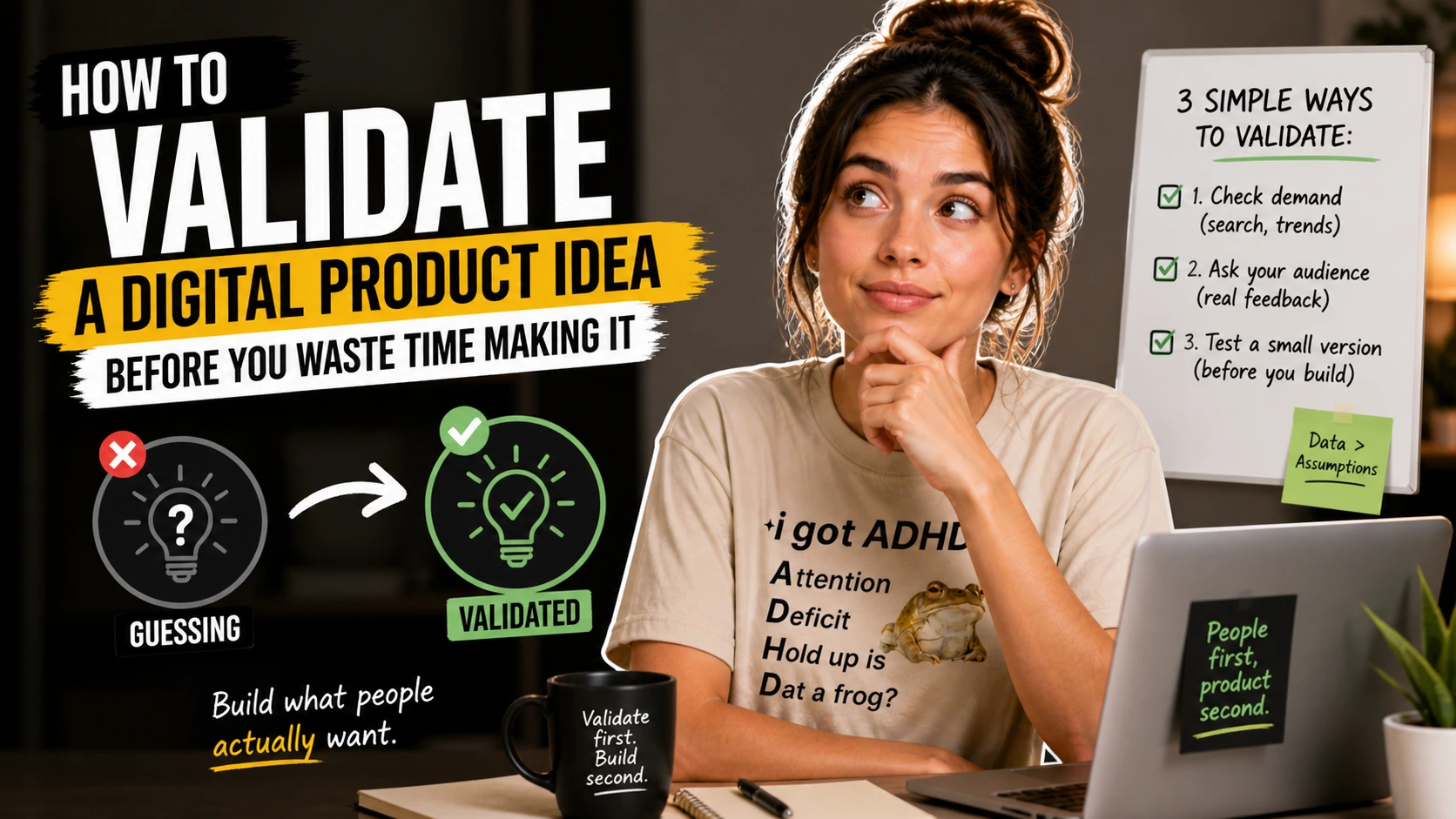
How to Validate a Digital Product Idea Before You Waste Time Making It
A product idea can sound solid until someone asks who it is for, what problem it solves, or why anyone would pay for it. “A mindset workbook for anyone who wants more clarity” may sound promising at first, but once you look closer, the buyer is blurry, the outcome is vague, and the reason to choose it over anything else starts to fade.
That is how a lot of weak product ideas lose momentum.
Not because the creator is lazy, and not because they lack discipline, but because the idea never got tested in a practical way before the build started. The concept felt interesting, which is not the same as feeling useful. Validation helps you catch that early.
It gives you a way to check whether the idea is specific enough, clear enough, and grounded enough to deserve your time before you spend days or weeks making the full version.
Building is emotionally expensive, even when the product is small. If you pour energy into something that was never very clear to begin with, the frustration later can feel heavier than the work itself.
What Validation Really Means
In digital products, validation does not mean proving with total certainty that something will sell. It means reducing obvious risk before you build by checking whether the product idea makes practical sense in the first place.
That is a much calmer standard.
You are not trying to predict the future perfectly. You are trying to avoid obvious mistakes like building for a buyer you cannot picture, solving a problem nobody feels strongly enough about, or choosing a format that does not match the job. A lot of people skip this because validation sounds big and formal.
Usually it is simpler than that.
Validation can be as basic as trying to explain the product in one sentence, comparing it to what already exists, writing a mock description, or testing whether a tiny version of the idea actually helps someone do something real. It is less about ceremony and more about pressure-testing.
The One-Sentence Test
A strong product idea is often easy to describe in one sentence. Not because all good ideas are simple, but because a clear buyer and a clear job usually make the product easier to say out loud.
If you cannot explain what the product does without leaning on vague words like clarity, growth, productivity, support, or success, that is usually a sign the concept still needs tightening.
Those words are not useless, but they often cover weak thinking when they show up too early. Compare “a workbook for people who want to feel more confident” with “a discovery call prep workbook for new coaches who freeze before sales calls.” The second one gives you a lot more to work with right away.
You can picture the buyer, the moment of use, and the reason they might want help. That does not guarantee the product will sell, but it does tell you the idea has a clearer shape.
Interesting Is Not Enough
This is one of the most important distinctions to make before you build anything. Some ideas sound creative, smart, or fresh, but they are still weak as products because they do not solve something people actually deal with in a repeated or meaningful way.
An idea can be cool and still not deserve a product.
That sounds a little blunt, but it is actually helpful, because it keeps you from confusing your own curiosity with buyer demand. Someone might be intrigued by a broad self-reflection deck for modern life. But would they buy it, use it, and recommend it?
That depends on whether it fits a real use case, not whether the phrase sounds appealing on social media.
Useful ideas usually connect to friction, repetition, confusion, delay, inconsistency, or a result people already care about. A checklist that helps freelancers remember client follow-ups has a clearer job than a general “business momentum” tool. A workbook for first-time Etsy sellers writing product descriptions is easier to validate than a workbook for “creative business growth.”
Check Whether the Problem Shows Up in Real Life
Before you worry about platforms, branding, or page count, ask whether the problem actually shows up in real life. Does someone deal with this repeatedly, or is it only mildly interesting when described in abstract terms?
This is where plain observation helps more than dramatic market research.
Look at your own work, client questions, community comments, saved notes, repeated frustrations, and the kinds of messy tasks people keep trying to patch with reminders, Google Docs, screenshots, or mental effort. A real product problem usually has some friction in it. It is annoying, recurring, unclear, or takes more energy than it should.
That is why a checklist can work well when it helps with a repeated task people keep forgetting.
It is why a template idea can feel stronger when it removes a clumsy step someone does all the time. And it is why some workbook topics feel weak, because the problem is too broad to feel urgent, practical, or specific.
Picture the Buyer Clearly
A lot of product ideas quietly fail because the buyer is too fuzzy. “Busy women,” “small business owners,” and “creatives” can all sound usable until you actually try to make decisions for them.
The problem with a vague buyer is that everything gets harder.
The title gets weaker, the examples get generic, the tone gets blurry, and the product starts trying to serve too many people at once. Validation gets easier when the buyer becomes easier to imagine. A travel nurse, a new coach, a parent homeschooling a preschooler, an Etsy seller making handmade jewelry, a therapist building gentle client resources.
These are all clearer than trying to make something for “everyone who wants help.”
You do not need the niche to be obscure. You just need it to be specific enough that the product can make sense in one person’s hands. If you cannot picture the buyer using the product in a real moment, the idea probably needs more work.
Existing Products Are Useful Clues
Some people worry that finding similar products is a bad sign. Usually it is the opposite.
If products like yours already exist on Gumroad, Etsy, Amazon KDP, or creator websites, that often means people can understand the category and may already be willing to buy in it.
The question is not whether your idea is completely original. The question is whether your version is specific enough, useful enough, or shaped clearly enough to deserve space beside the others. This step is not about copying. It is about reality-checking.
If you find many products that look close to your idea, study what they promise, how they are packaged, and what kind of buyer they seem to target.
If you find almost nothing, that does not automatically mean you found a hidden gem. Sometimes it means the idea is too awkward, too narrow in the wrong way, or too weak to attract real demand. You need judgment here, not just excitement.
Write the Sales Description First
This is one of the fastest ways to validate an idea. Write a short mock product description as if the product already exists and you are trying to sell it to the right buyer.
That exercise reveals a lot quickly.
If you struggle to explain what is included, who it helps, what it helps with, and why the buyer would care, the idea probably is not ready yet. Good product descriptions usually get clearer when the idea is strong. You can say what it is, who it is for, and what kind of result or relief it offers without sounding inflated.
Weak ideas often need decorative language to survive.
They lean on vague transformation, broad promises, or polished wording that sounds nice but still leaves the reader wondering what they are actually buying. AI can help you draft these descriptions faster, but that is exactly why you have to be careful. A smooth paragraph is not proof that the idea is sound.
Compare Competing Ideas Side by Side
When you have too many ideas, it helps to compare them directly instead of judging each one in isolation. Often the stronger product becomes obvious once two similar options sit next to each other.
Maybe you are choosing between a workbook for “content clarity” and a swipe file for client follow-up messages.
Or between a broad teacher planner and a lesson-sequencing checklist for tutors. Or between a niche app for session recaps and a giant all-purpose coaching dashboard. Side-by-side comparison forces better questions.
Which one has a clearer buyer? Which one solves a more repeated task? Which one is easier to explain in one sentence? Which one sounds easier to package and try selling without building for three weeks first?
That kind of comparison is practical validation. It helps you choose the idea with the cleanest path, not just the one that gives you the biggest burst of inspiration on a Tuesday afternoon.
Try a Tiny Version Before the Full Build
Sometimes the best validation is making a very small version instead of building the full product right away. Not a giant launch, and not a polished flagship offer.
Just enough to test whether the product feels useful in real use.
A checklist can be tested as a one-page PDF before it becomes a larger pack. A workbook topic can be tested with five strong prompts before you write thirty. A template idea can be tried with two files instead of twelve.
A niche app can start as one core workflow before any extra features show up.
This works because usefulness shows up fast. Either the small version helps, or it does not. A tiny first version can show you whether the concept is strong enough to keep going, whether it needs tightening, or whether it should be dropped without drama.
Where AI Helps, and Where It Can Mislead You
AI is genuinely helpful during validation. You can use ChatGPT, Claude, or Gemini to brainstorm angles, narrow a buyer, compare positioning options, generate mock descriptions, organize messy thoughts, and test whether one version of an idea sounds clearer than another.
It is especially useful when your head is crowded and every idea feels equally possible.
AI can help you turn loose notes into cleaner product concepts faster, which makes decision-making less foggy. But it can also make weak ideas sound polished. A bland workbook can suddenly sound thoughtful after AI rewrites the copy.
A vague app idea can sound impressive after a neat paragraph explains the future vision.
None of that changes whether the buyer is clear, whether the problem is real, or whether the product deserves the effort. Human judgment still has to ask the annoying questions polished wording likes to hide.
Ready, Not Ready, or Ready to Drop
An idea is probably good enough to build when the buyer is easy to picture, the problem feels real, the format makes sense, and the value is easy to explain without dramatic language. It does not need to feel perfect.
It just needs to feel specific and grounded enough that a first version is worth the time.
It probably needs tightening when the core is promising but still a little broad. Maybe the buyer is too loose, the title is fuzzy, or the format is not quite right yet. That is often fixable. And sometimes the best call is to drop the idea.
Not because you failed, but because the product never got specific enough to stand up once you tested it properly.
That is what validation is really for. Not to make you wait forever, and not to eliminate every risk, but to help you spend your effort on ideas that have enough shape, usefulness, and clarity to become real products instead of just interesting thoughts.
