
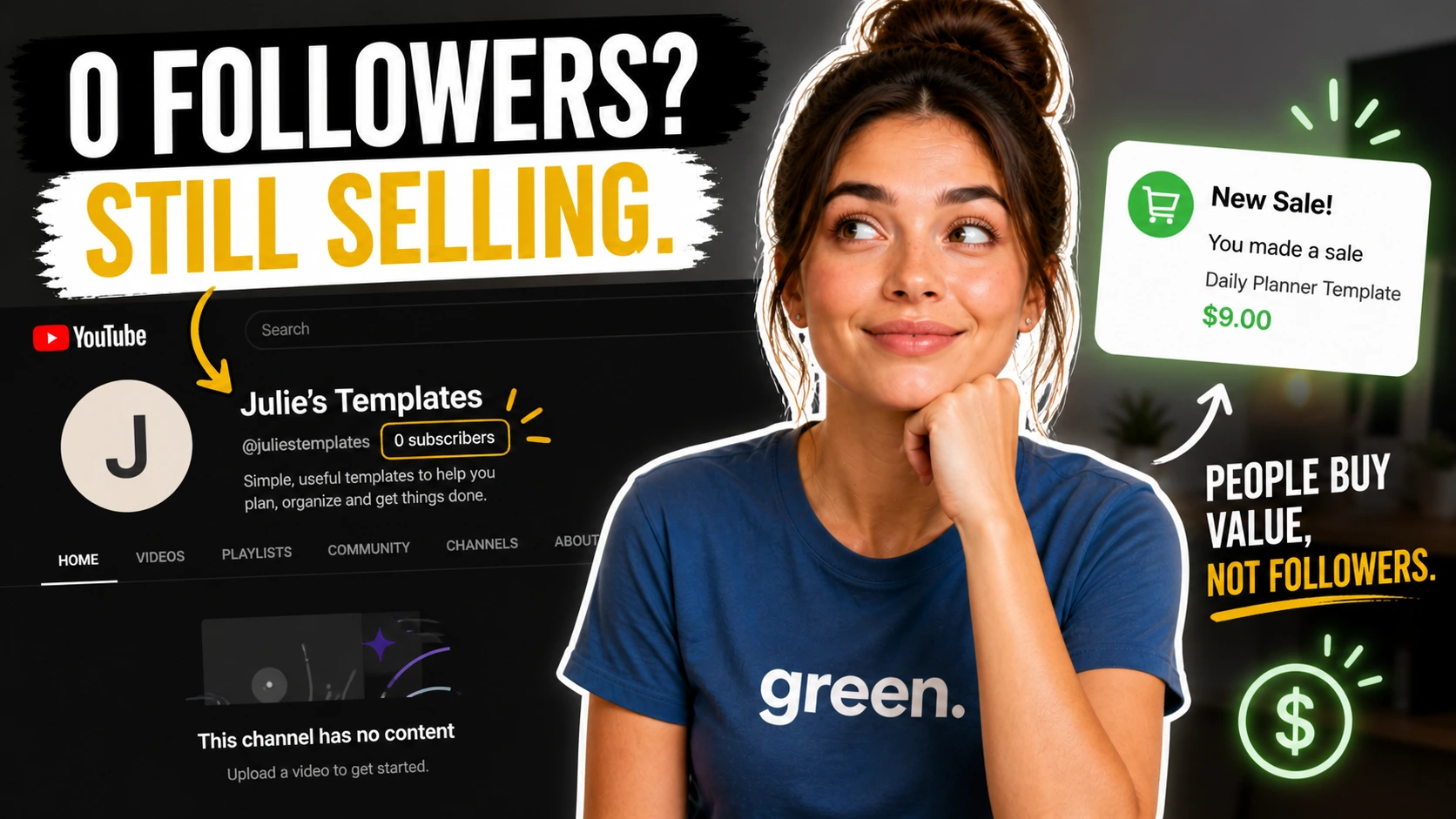
Trust Without Followers
Most advice about selling online assumes you have an audience.
Build a following first. Warm them up. Launch to people who already know you.
This doesn’t help if you’re starting from zero. No followers. No email list. No platform presence.
But you can still create trust. Just not through personality or popularity.
Through clarity.
Proof Is Visual
When strangers land on your listing, they’re trying to answer one question.
Will this actually help me?
You can’t answer with testimonials you don’t have. You can’t answer with follower counts or social proof.
But you can answer with what they can see.
Show the template working.
Screenshots of the template filled in with example content. Before and after images that demonstrate the transformation. A view of the structure that makes the logic visible.
Visual proof doesn’t require anyone else to vouch for you. It lets the template speak for itself.
Before and After
The simplest form of proof is showing the change.
Before: the messy state. The scattered notes. The blank page. The confusion someone feels when they don’t have your template.
After: the organized state. The clear structure. The filled-in sections. The calm of having a system.
You don’t need a real customer to create this. You can make it yourself.
Create a screenshot of what the problem looks like. Then show what it looks like solved with your template.
This isn’t deception. It’s demonstration. You’re showing what the template does, not claiming someone else used it.
I remember sitting at my desk trying to figure out how to make my template seem legitimate. No buyers yet. No reviews. Nothing to point to.
Then I realized I could just show it working.
I filled in the template with realistic example data. Took screenshots. Arranged them to show the flow from empty to complete.
The glow of the screen reflected back something that looked real. Because it was real. Just demonstrated, not testimonial.
Example Content as Proof
The examples inside your template do double work.
For the buyer, they clarify how to use each section.
For the stranger on the listing page, they prove the template is useful.
When your screenshots show filled-in content instead of empty boxes, people can imagine themselves using it. They see the format. They understand the intention. They feel less risk.
Empty templates look like ideas. Filled templates look like tools.
I used to think example content cluttered things. Made the template feel less clean. Less professional.
Actually, the opposite was true. Clean and empty feels uncertain. Populated and practical feels trustworthy.
The Guide Page as Credibility
Including a guide page inside the template also builds trust.
Not because it’s impressive. Because it shows you thought about the buyer’s experience.
You anticipated their questions. You explained the purpose. You cared enough to help them succeed.
This signals something. That the creator is thoughtful. That the template was made with attention.
Strangers notice this. Maybe not consciously. But they feel the difference between a template that was thrown together and one that was considered.
The guide doesn’t need to be long. One page. A few paragraphs. But its presence matters.
Clarity Beats Claims
You could write “This template will transform your workflow” on your listing.
But claims without evidence feel hollow.
Better to describe the specific problem and show exactly how the template addresses it.
“This checklist helps you review your week in fifteen minutes. Here’s what the filled-in version looks like.”
That’s not a claim. That’s a demonstration with context.
Strangers trust clarity more than promises. They’ve seen too many promises. They’ve been disappointed before.
But clarity is harder to fake. When something is explained simply and shown honestly, it feels different. Safer.
Starting With Nothing
You don’t need an audience to make your first sale.
You need a template that clearly solves a real problem. A listing that explains that problem honestly. Screenshots that show the solution in action. Examples that demonstrate how it works.
All of this is within your control. Right now. Without followers.
The first buyer might find you through a random search. Through a marketplace browse. Through a link you shared in one small community.
They won’t know you. They’ll only know what they see on the page.
Make what they see enough.
I remember refreshing my Gumroad dashboard in those early days. Zero sales. The number felt personal.
But the zero wasn’t about me. It was about visibility. About finding the right person who needed what I’d made.
When the first sale came, it came from a stranger. Someone I’d never interacted with. They saw the listing, understood the value, and bought.
No audience required. Just clarity.
