AI Helps, You Decide
AI can make template work easier.
But easier isn’t always better. Especially when easier means skipping the thinking that makes your template yours.
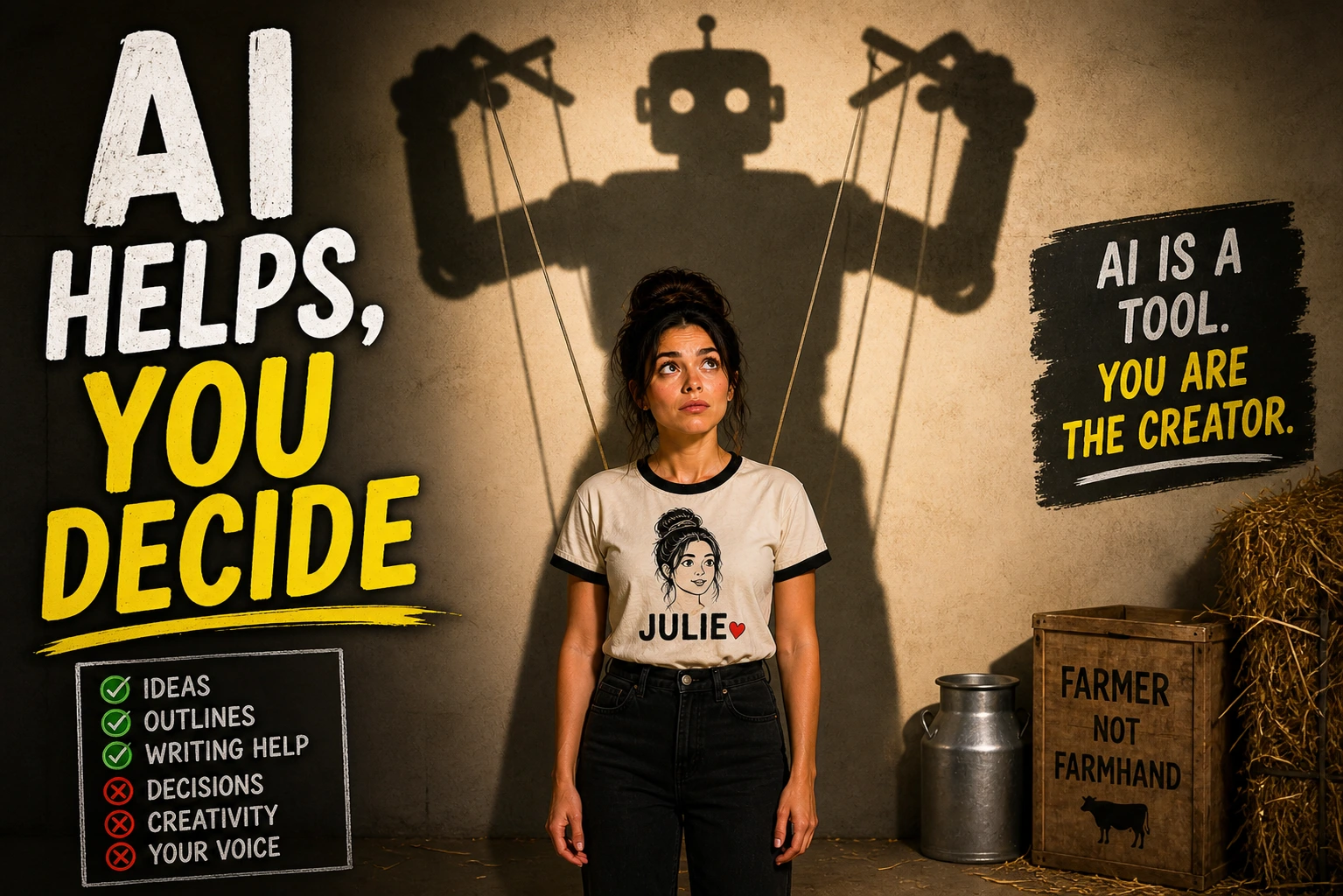
The line matters. On one side, AI assists your expression. On the other side, AI replaces your decisions.
Staying on the right side of that line is the whole skill.
What AI Does Well
AI is good at taking something rough and making it clearer.
You write instructions for your template. They make sense in your head but read clunky on the page. You paste them into a chat and ask for a cleaner version.
AI returns something smoother. You read it. Keep some phrases, adjust others, delete the parts that don’t sound like you.
That’s assistance. Your thinking stayed. The words improved.
AI is also good at offering options.
You have an idea for a checklist but you’re not sure how to organize it. You describe the purpose and ask for three possible structures.
AI suggests groupings. By phase. By priority. By time. You look at them and one feels right. You build from there.
That’s collaboration. AI suggested. You chose.
AI is good at simplifying.
You wrote a paragraph explaining how to use a section of your template. It’s accurate but long. You ask AI to say the same thing in fewer words.
AI compresses it. You check that the meaning survived. It did. You use the shorter version.
That’s editing. The idea was always yours.
What AI Does Poorly
AI is bad at knowing what matters.
It can generate a complete template in seconds. All the sections filled in. All the placeholders labeled. Looks finished.
But it doesn’t know why those sections exist. It doesn’t know what you learned from doing the thing yourself. It doesn’t know which steps people actually get stuck on.
AI fills space. It doesn’t feel friction.
A template generated entirely by AI has no lived experience behind it. No decisions made from real use. No texture that comes from trial and error.
It’s smooth in a way that feels empty.
I tried this once, early on. Asked AI to create a full content planning template. It produced something in about a minute. Looked professional. Had all the expected sections.
I stared at the screen and felt nothing. No ownership. No recognition.
It wasn’t mine. I hadn’t made any decisions. I’d just asked and received.
That template never shipped. Not because it was bad. Because I couldn’t explain it. I didn’t understand why each section was there. When I tried to improve it, I didn’t know what to change.
The One-Prompt Rule
Here’s a test that helps.
If AI can make your template in one prompt, it’s probably not worth making.
Because one prompt means the structure is obvious. Generic. Already everywhere.
If someone can type “make me a weekly planner” and get something equivalent to your template, then your template has no edge.
The value in a template comes from decisions AI can’t guess. Specific sequences. Unusual categories. Gaps left intentionally because you know that part varies.
These come from experience. Not from prompts.
Where the Line Is
Use AI to clarify what you’ve written. Not to write what you haven’t thought.
Use AI to suggest structures. Not to choose which structure is right.
Use AI to simplify wording. Not to generate ideas you don’t have.
The line is between expression and decision.
AI can help with expression. You keep the decisions.
Actually, I want to soften that slightly. Sometimes asking AI to brainstorm can spark something. You’re stuck. You describe your problem. AI throws out ten directions.
Nine are generic. One triggers a thought you wouldn’t have had alone.
That’s fine. The thought is yours once you have it. The decision to pursue it is yours.
The danger is when you skip your own thinking entirely. When AI decides what the template should be, who it’s for, and how it should work.
Then it’s not your template. It’s AI’s template with your name on it.
Keeping the Work Yours
The cursor blinks in the chat window. You can ask anything.
This power is easy to misuse. Not maliciously. Just lazily. It’s late. You’re tired. Generating feels faster than thinking.
But templates made from thinking last. Templates generated from prompts feel thin. Even if you can’t articulate why.
The people who download your template can feel it too. The difference between something crafted and something assembled.
One has weight. The other doesn’t.
AI helps carry the weight. It doesn’t create it.
