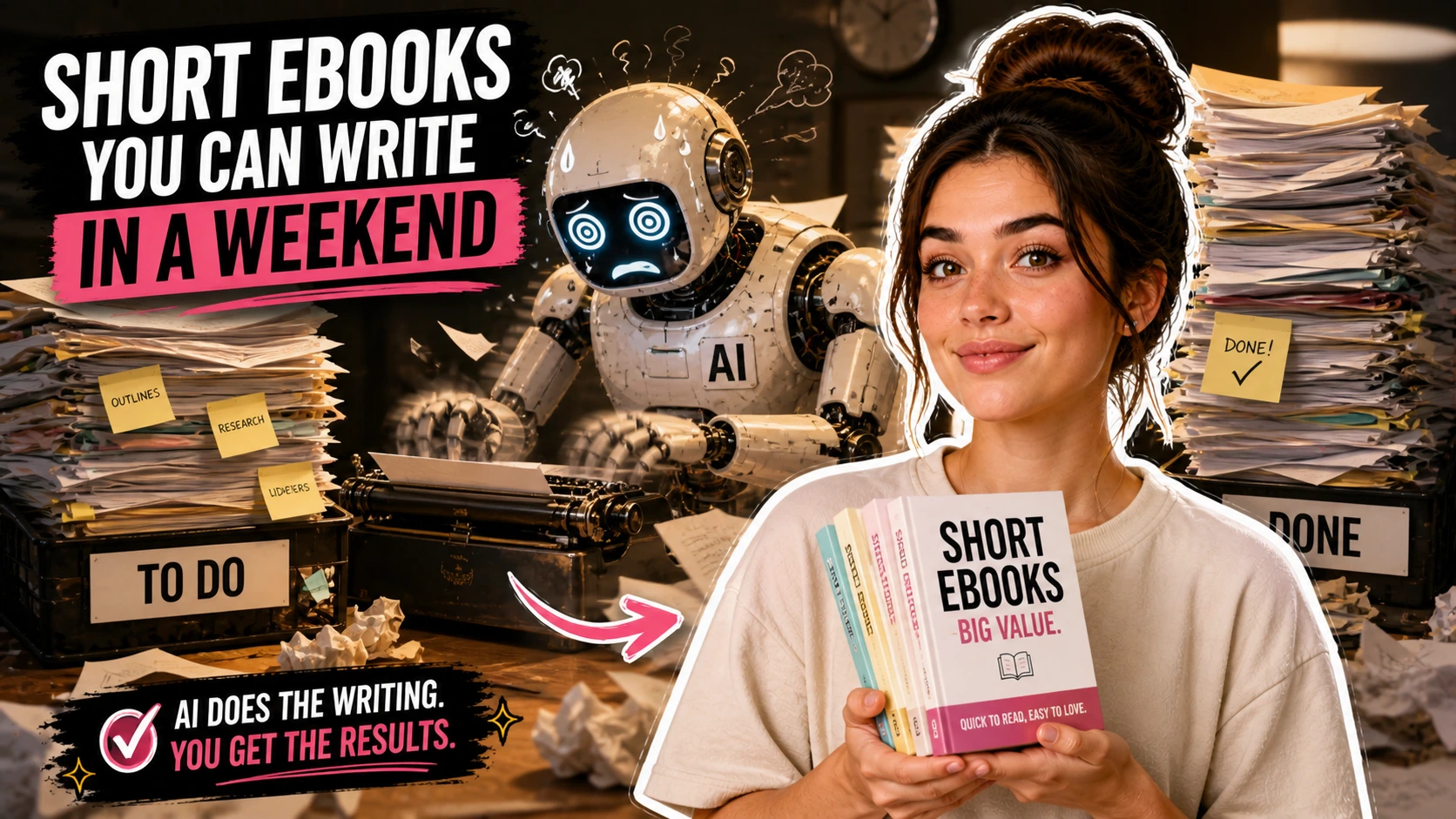
Short Ebooks You Can Write in a Weekend Using AI
A lot of useful ideas fall apart the moment someone tries to turn them into a big book. What starts as a clear, helpful guide to one problem suddenly expands into chapters on background, theory, advanced tips, bonus topics, and things the reader never came for in the first place.
That is usually where the project starts to drag.
The scope gets wider, the writing gets blurrier, and the original point gets buried under the pressure to make the ebook seem bigger than it needs to be. A short, focused ebook often works better because it fits the way people actually buy and read digital products. Most readers are not looking for a giant reference manual when they are trying to solve one pressing problem on a Tuesday night.
They want a guide that gets to the point, helps them see what to do next, and does not make them dig through filler to find the part that matters.
That is why a short ebook can be easier to create and easier to sell than an oversized idea pretending to be a big book.
Between a Blog Post and a Book
A short ebook sits in a very specific middle ground. It is not just a blog post saved as a PDF, and it is not a full traditional book trying to cover every part of a topic from every possible angle.
A blog post can be useful, but it is usually lighter, faster, and less structured. A full book asks for a much bigger commitment from both the creator and the reader.
A good short ebook is tighter than a long book and more complete than a free article.
It usually focuses on one defined reader, one clear promise, and one practical outcome. That could be a guide to setting freelance rates for new designers, a beginner meal-prep system for ADHD households, or a simple local SEO guide for photographers who hate marketing.
Each of those topics is narrow enough to explain properly without wandering into ten side topics. This is also what separates a paid short ebook from a lead magnet. A free PDF often introduces an idea or gives a checklist.
A paid short ebook usually walks the reader through a problem in a way that feels organized, finished, and worth coming back to.
Why Short Guides Still Sell
People do not usually pay for page count by itself. They pay for relevance, structure, and the feeling that someone has already done the sorting for them.
That matters more than many creators expect.
A 25-page guide that answers the exact question someone has can feel more valuable than an 80-page ebook that circles around five related topics without ever getting especially clear. There is a real sense of relief in reading something that feels well scoped.
You can tell when a creator knows exactly what belongs in the guide and what should stay out.
That feeling is part of the product. A sellable short ebook tells the reader, “I know why you picked this, and I’m not going to waste your time.” This is especially true for beginners, busy professionals, parents, consultants, and people who already feel overloaded.
They often want focused guidance they can use quickly, not a long educational journey that asks them to become a mini-expert before they can do anything with it.
So the value is not “more information.” The value is getting to understanding and action faster.
Smaller Topics, Stronger Products
The hardest part is often choosing a topic small enough to finish. Many creators begin with “everything you need to know” because it sounds more important, but that kind of promise usually leads to weak chapters and endless revision.
A better question is this: what is one situation someone is in, and what is one useful result they want?
That framing usually leads to much stronger ebook ideas. Instead of “The Complete Guide to Freelancing,” a short ebook could be “How to Set Freelance Rates Without Guessing.” Instead of “Meal Planning for Families,” it could be “A Simple Meal-Prep System for ADHD Households That Cuts Decision Fatigue.”
Those narrower ideas are easier to outline, easier to finish, and usually easier to sell because the buyer can recognize themselves right away.
They do not have to wonder whether the ebook might help. They can see the fit almost immediately. This is where AI can be genuinely helpful.
You can ask ChatGPT, Claude, or Gemini to turn a broad subject into ten narrower angles, compare which ones have a clear buyer, and suggest tighter promises that sound practical instead of inflated.
But AI will almost always try to widen the scope if you let it. It likes adding “important background,” extra chapter ideas, and a kind of generic completeness, so you still have to decide what the ebook is really about and what needs to be cut.
What Makes It Feel Worth Buying
A paid short ebook needs more than a decent topic. It needs enough substance and order that the buyer feels guided, not brushed past.
That usually means a clear title, a subtitle that tells the reader what problem it helps with, and a simple chapter flow that builds naturally. The chapters do not need to be long, but they should each earn their place.
A strong short ebook often includes a quick framing section, a few focused chapters, specific examples, and a closing section that helps the reader act or think more clearly.
It does not need ten templates, seven bonuses, and a giant appendix unless those things genuinely improve the result. The difference between a padded mini-book and a useful short ebook is easy to feel.
One repeats itself, stretches common knowledge, and tries to look bigger than it is.
The other says something direct, gives the reader enough context to use the advice, and leaves them better equipped than before. That is a much better reason to charge for it.
Where AI Helps and Where It Bloats
AI is very good at helping you move from scattered notes to a first draft. If you already have a rough idea, it can help brainstorm angles, build chapter options, draft awkward sections, improve transitions, and suggest examples you can adapt.
That speed matters because blank-page friction is real. A lot of useful ebook ideas die not because the topic is bad, but because the creator keeps circling the draft without finding a clean starting point.
Google Docs works well for this stage because it keeps the drafting simple.
You can use ChatGPT, Claude, or Gemini beside your draft to test titles, rewrite weak paragraphs, or tighten chapter openings. But AI also creates a very specific problem. It fills space too easily.
The draft starts sounding smooth while quietly becoming repetitive, broad, and generic. You may read it and think, “This sounds fine,” and then realize a page later it has made the same point three times in slightly different wording.
That is where human judgment matters most.
You need to cut filler, bring the real reader back into view, and keep asking whether each section deserves to stay. A good test is simple: if you removed this paragraph, would the buyer lose anything useful? If the answer is no, it probably does not need to stay.
A Realistic First Version
Your first version does not need to be impressive in some dramatic way. It needs to be clear, complete, and polished enough that a buyer can use it without confusion.
For many short ebooks, that might mean 20 to 40 pages of actual value, depending on formatting, examples, and spacing.
On Amazon KDP, it may look more like a traditional book, while on Gumroad or your own site it might feel more like a focused digital guide. You could create a short ebook called Setting Freelance Rates Without Freezing Up.
It might have a brief intro, a chapter on common pricing models, a chapter on choosing a baseline rate, a chapter with three sample client scenarios, a short section on raising rates, and a final page with a pricing worksheet.
That is not huge, but it is useful. And useful is what makes it sellable.
Visually, the packaging matters too. A clean cover in Canva, readable headings, consistent formatting, and a professional PDF export can make a small product feel deliberate instead of thrown together.
If you are publishing to KDP, you will need a properly formatted manuscript and cover dimensions that fit Amazon’s requirements. If you are selling direct, a polished PDF and a clear sales page are usually enough to get started.
Match the Platform to the Product
Where you sell the ebook should match how the product is meant to be discovered. The same guide can feel very different depending on the platform.
Amazon KDP is useful when the ebook has a more book-like position and can benefit from marketplace visibility.
People already browse Amazon looking for guides, and the format makes even a short book feel established, though competition is higher and the presentation needs to be strong. Gumroad is better when you want direct sales to your audience, email list, social followers, clients, or niche community.
It is often the simplest way to sell a focused PDF, especially if the topic comes from your own experience and you can explain clearly who it is for.
Etsy can work, but only in some cases. The ebook usually needs to fit digital-download shopping behavior, and the listing has to make the value obvious very quickly.
That means a highly practical topic, a clear visual presentation, and a buyer who is already comfortable purchasing downloadable resources there. A general advice ebook may struggle on Etsy, while a very specific niche quick-start guide might fit better. A personal site can work well too, especially for coaches, consultants, and educators who want more control over pricing, presentation, and email capture.
It asks for more trust-building, but it can also make the product feel closely tied to the rest of your work.
Day 1, Week 1, Month 1
On Day 1, spend about two to three hours narrowing the topic. Choose one reader, one problem, and one result, then use AI to generate possible outlines and title directions.
In another two hours, pick the strongest outline, cut any chapter that feels like a side path, and create a rough draft structure in Google Docs.
By the end of the day, you want a title, subtitle, chapter list, and a messy first pass at at least one or two sections. During Week 1, plan on six to ten total hours if you are working around a job or family life.
Draft the full ebook with AI support, but revise each chapter yourself so it sounds direct and grounded instead of padded.
Then spend a few hours on cleanup. Add examples, tighten the wording, check transitions, make sure each section leads naturally to the next, and turn the draft into a polished PDF or a KDP-ready manuscript.
By Month 1, the goal is not to build a publishing empire.
The goal is to have one finished product live somewhere real, with a simple cover, a clear description, preview images or sample pages, and enough feedback from actual readers or buyers to improve the next version. That month is also when you learn what the ebook actually is in the market.
You may discover the title needs sharpening, the promise needs narrowing, or buyers respond most strongly to one chapter you nearly cut.
And that is useful information. A short ebook is small enough to revise without dread, which makes it one of the more forgiving digital products to build, test, and improve.
The Advantage of Staying Small
A short ebook works because it does not try to do everything. It makes a smaller promise and has a much better chance of keeping it.
That can feel almost modest to the point of discomfort at first, especially if you are used to thinking bigger automatically means more valuable.
But readers usually remember the guide that helped them move, not the one that impressed them with length. So if you have a useful idea that keeps collapsing under the weight of becoming a “real book,” it may not need to grow.
It may need to get narrower, clearer, and more honest about what it is actually trying to help with.
