
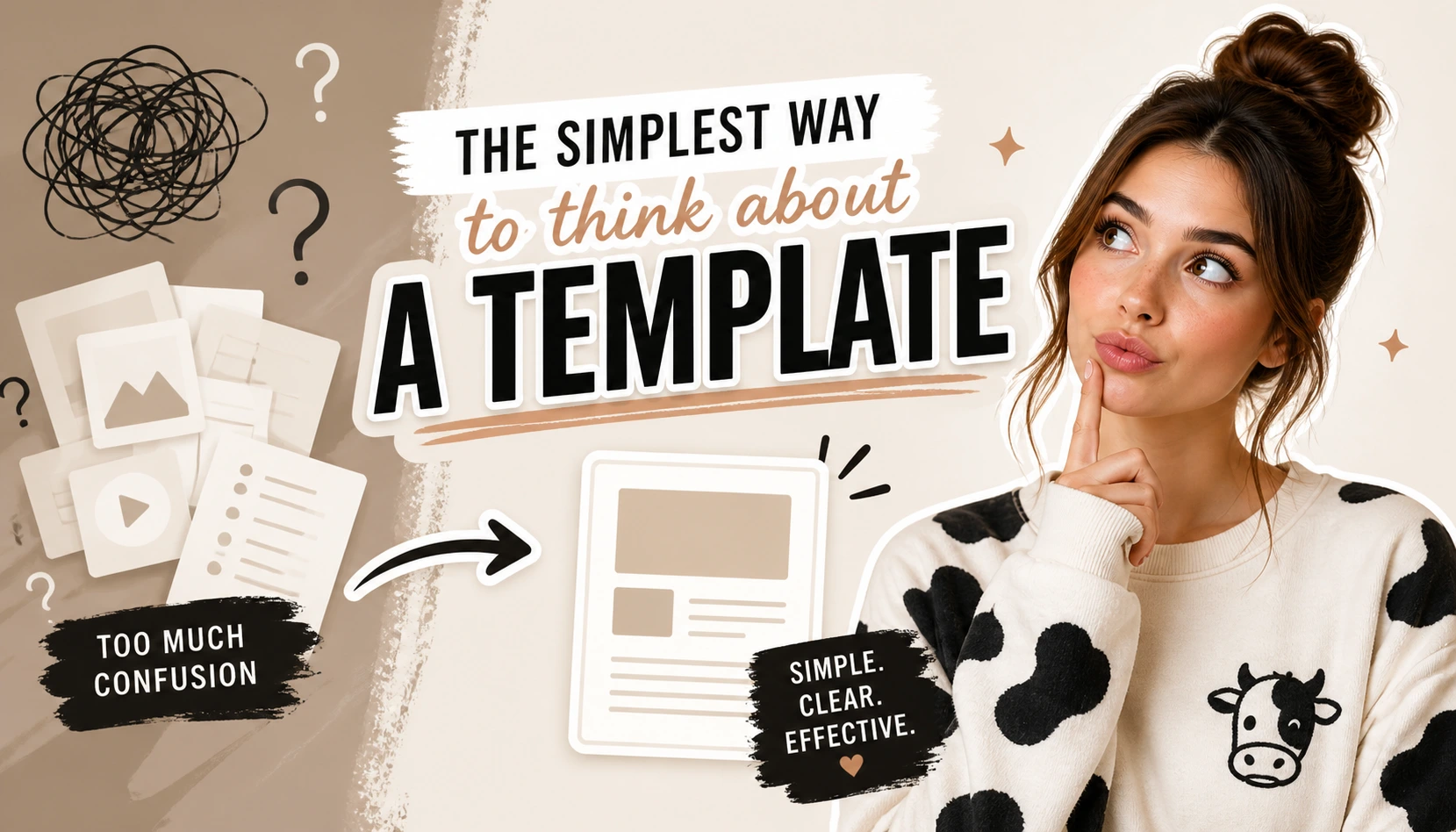
The Simplest Way to Think About a Template
A template is a decision you made once so someone else doesn’t have to.
That’s it.
Not a design. Not a product. Not a file type.
A decision, made ahead of time, packaged into something reusable.
Why This Definition Matters
Most people think templates are about aesthetics. Pretty planners. Color-coded spreadsheets. Minimalist Notion dashboards with nice fonts.
Those things exist. They sell sometimes.
But decoration is not what makes a template useful.
What makes a template useful is the thinking already done inside it.
Someone opens your template and they don’t face a blank page. They don’t have to figure out what goes where. They don’t have to decide the categories, the order, the structure.
You decided. They just fill in.
Three Levels of Template Usefulness
Not all templates carry the same weight. Some do more work than others.
Level one is layout.
A layout template gives someone a visual starting point. A page divided into sections. A grid. A frame to work inside.
This helps, but only slightly. The person still has to decide what to put in each section. The thinking stays with them.
Level two is structure.
A structure template tells someone what belongs where. Labels already there. Categories pre-set. The sections have names now.
This helps more. The person sees what kind of information goes in each spot. Less guessing.
Level three is logic.
A logic template guides decisions. It might ask questions. It might include criteria. It might move someone from confusion to clarity through a sequence of steps.
This is where templates become genuinely useful. The thinking is embedded.
I didn’t understand this for a while, actually. I thought the goal was to make something that looked complete. But looking complete and being useful are different things.
Decoration vs. Usefulness
Here’s a test.
If you removed all the colors, fonts, and styling from your template, would it still help someone?
If yes, you have something useful.
If no, you have decoration.
Decoration can sell. People buy pretty things. But pretty things without usefulness get downloaded and forgotten. Opened once, then closed.
Useful templates get used.
There’s a quiet satisfaction when someone actually uses something you made. I remember checking Gumroad analytics one morning, still half-awake, scrolling past the download count to see if anyone left a review. One person had. They said the template helped them finish something they’d been avoiding for weeks.
That felt different than a sale.
The Lane Idea
This connects to something that will matter later. The idea of one lane.
A template doesn’t need to solve every problem. It doesn’t need to serve every person.
It needs to solve one problem, for one kind of person, in one situation.
That’s a lane.
The narrower the lane, the more useful the template becomes. Because you can make decisions more specifically. You can structure things for that exact situation. You can embed logic that actually fits.
Wide templates try to help everyone. They end up helping no one deeply.
Narrow templates feel limiting to make. But they’re easier to finish. And they’re easier to explain.
I think I resisted this at first because narrow felt small. Like I was leaving people out. But small is not the same as weak and this took me longer to accept than it probably should have.
A template that helps ten people solve one specific problem is more valuable than a template that vaguely helps a thousand people think about general things.
What This Means for Starting
You’re not building a product empire. You’re not designing a brand.
You’re making one small container for decisions you’ve already made.
It might be a checklist for something you do every week. It might be a set of questions you ask yourself before making a certain kind of choice. It might be a structure you use to organize one recurring task.
The template already exists in your habits somewhere. You just haven’t pulled it out yet.
So the question isn’t what should I create.
The question is what do I already do that has a repeatable shape.
That shape, externalized, is a template.
Not everyone will want it. But someone might. And that someone is enough to start.
The cursor blinks on a blank Notion page. The blinking used to feel like pressure. Now it just means the page is waiting.
Nothing has to be perfect yet.
